Lincoln Wheat Penny · WWII Shell Case Bronze · 1944

1944 Wheat Penny Value, Error list & Coin Identifier App

From common copper cents worth a few cents to steel planchet errors worth $408,000 — the complete collector guide.

2.1B+

Total Minted

~30

Steel Errors Known

$408K

Top Auction Record

6

Error Types

Contents

The 1944 wheat penny marks one of the most dramatic transitions in American coinage history. After a year of striking zinc-coated steel cents to conserve copper for World War II, the U.S. Mint returned to traditional bronze in 1944 — but with a twist. Raw material came directly from spent battlefield shell casings, giving every 1944 Lincoln cent a literal connection to the war effort. The JM Bullion 1944 Lincoln Penny guide provides current melt values and certified population data for all three mint varieties, which is essential reading before you buy or sell.

1944 Wheat Penny at a Glance

  • Composition: 95% copper, 5% tin & zinc (shell case bronze)
  • Weight: 3.11g (steel error = 2.70g)
  • Diameter: 19.05mm — plain edge
  • Designer: Victor David Brenner (1909 original)
  • Total mintage: 2,148,738,000 across all three mints
  • Color grades: RD (Red) > RB (Red-Brown) > BN (Brown)
  • Mint marks: None = Philadelphia; D = Denver; S = San Francisco
  • NOT magnetic (genuine copper version)

Two billion pennies sounds impossibly common — and for most examples, it is. A well-worn 1944-P in G-4 grades out to face value. But rarity emerges from condition, color, and above all errors. The handful of steel planchet errors accidentally struck on leftover 1943 steel blanks are among the most valuable Lincoln cents ever produced. Even among ordinary copper examples, a fully Red MS-67 from any mint commands three to four figures at major auction houses.


Quick Value Check

Check these three factors first before diving deeper

🔴

Stop — Test First

Hold a magnet near the coin. If it sticks strongly, you may have a rare 1944 steel penny worth $75,000–$408,000. Get it authenticated immediately.

🟡

Examine Closely

Use 10x magnification. Look for a hidden “S” beneath a “D” mintmark (D/S variety), doubled letters on LIBERTY, or off-center design.

🟢

Grade the Condition

Original red luster? Nearly full wheat lines on reverse? MS-65 RD or better can be worth $50–$200+. BN circulated examples: a few cents.

What You See Likely Scenario Estimated Value Next Step
Silvery color, sticks to magnet, 2.7g 1944 Steel Penny Error $75,000–$408,000+ PCGS/NGC immediately
D mintmark, S trace visible beneath D/S Overmintmark $50–$49,938 Authenticate & grade
Doubling on LIBERTY or date DDO variety $100–$1,000+ Compare to known varieties
Full red luster, sharp strike, MS-66+ Premium mint state $50–$300 Consider grading
Partial design, blank area visible Off-center strike $20–$400 Measure offset %
Normal copper, worn, any mint Common circulated $0.05–$0.50 Keep for sets

Varieties & Mintage

Three mint facilities — over two billion struck in WWII’s final year

Variety Mintmark Mintage Rarity (circulated) Notes
1944-P None (Philadelphia) 1,435,400,000 Very abundant MS-67 RD commands premium; D/S error from this mint is legendary
1944-D D (Denver) 430,578,000 Abundant Source of D/S overmintmark; 7 steel errors known
1944-S S (San Francisco) 282,760,000 Abundant (slight premium) Only 2 steel errors known; rarest and most valuable steel variant

⚠ Why the Steel Errors Exist

When the Mint transitioned from steel back to bronze in January 1944, a small number of leftover 1943 zinc-coated steel planchets — or steel blanks prepared for Belgian 2-franc coins — were accidentally mixed into the 1944 copper production run. The resulting steel cents dated 1944 are magnetically detectable and weigh 2.70g vs the standard 3.11g. Dozens of copper-plated fakes exist; only PCGS/NGC certification confirms authenticity.


Value by Grade

Copper (bronze) versions only — steel errors priced separately below

Circulated Grades (G-4 to AU-58)

Grade 1944-P 1944-D 1944-S
G-4 (Good)$0.05$0.05$0.10
VG-8 (Very Good)$0.10$0.10$0.15
F-12 (Fine)$0.15$0.15$0.25
VF-20 (Very Fine)$0.20$0.20$0.35
EF-40 (Extremely Fine)$0.50$0.50$0.75
AU-58 (About Uncirculated)$2$2$3

Mint State Grades (MS-60 to MS-67+) — by Color

Grade P — BN P — RD D — BN D — RD S — BN S — RD
MS-60$1$3$1$4$2$5
MS-63$3$8$3$10$4$12
MS-65$10$25$12$30$15$40
MS-66$30$75$35$90$40$110
MS-67$175$250+$110$175+$120$200+
MS-67+ / MS-68$1,000+$800+$900+

1944 Steel Penny: The Ultimate Rarity

Off-metal errors worth $75,000 to $408,000 — and easy to fake

⚠ CRITICAL AUTHENTICATION WARNING

Thousands of copper-plated steel pennies exist and are NOT magnetic to the same degree as genuine zinc-coated steel errors. Always weigh precisely (2.70g), test with a strong magnet, and submit to PCGS or NGC before assuming you have a genuine 1944 steel cent. Many altered 1948 pennies also circulate — check the “4” serif shape carefully.

~25–30

Philadelphia examples
(no mintmark)

Top sale: $180,000 (Heritage 2021)

~7

Denver examples
(D mintmark)

Top sale: $115,000 (2007)

2

San Francisco examples
(S mintmark) — scarcest

Top sale: $408,000 MS66 (Heritage 2021)

4-Step Authentication Guide

1

Magnet Test

A genuine zinc-coated steel cent will cling strongly to a neodymium magnet. Copper-plated fakes may react weakly. Copper cents do not respond at all.

2

Weight Check

Steel = 2.70g; copper = 3.11g. Use a digital scale accurate to 0.01g. Any weight other than 2.70g disqualifies the coin as a genuine 1944 steel error.

3

Color & Edge

Genuine zinc-coated steel has a silver-gray sheen; copper-plated fakes may show orange at the edge. Examine the edge under 10x magnification for zinc coating.

4

Date Serif Check

Altered 1948 dates are common fakes. On a genuine 1944, the “4” has a specific serif form. Compare to PCGS photo reference before submitting.


1944 Wheat Penny Error List with Pictures

Six documented error types — from $20 off-center strikes to $408,000 steel planchet rarities

The 1944 wheat penny’s unique historical context — caught between wartime steel production and the return to shell-case bronze — created a perfect storm of minting errors. Die shortages, rushed planchet changeovers, and record-breaking production volumes all contributed to the error varieties documented below. For the most current 1944 wheat penny value on specific error varieties, professional authentication is recommended for any coin potentially worth $200 or more.

Table 5: 1944 Wheat Penny — Error Coin Reference

# Error Type Rarity Circulated MS / Uncirculated
1Steel Planchet Error ⭐~30 known$75,000+$180,000–$408,000
2D/S Overmintmark (OMM)Est. 750,000$20–$150$1,000–$49,938
3Doubled Die Obverse (DDO)Several known$25–$100$100–$1,000+
4Off-Center StrikeOccasional$20–$75$75–$400
5Clipped PlanchetOccasional$10–$50$30–$100
6Double Denomination (Dime Planchet)Extremely rare$100,000–$500,000+

Error #1: Steel Planchet Error ⭐

The most valuable 1944 Lincoln cent error — worth six figures when authenticated
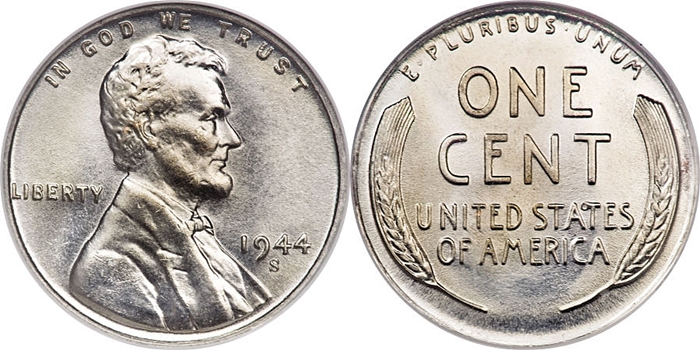
1944 penny steel planchet error

1944 Steel Planchet Error — silvery appearance, 2.70g, magnetic

Created when leftover 1943 zinc-coated steel planchets accidentally mixed with 1944 copper production. Philadelphia has ~25–30 confirmed examples, Denver just 7, and San Francisco only 2 — making the 1944-S steel cent one of the rarest coins in American numismatics.

How to identify: Clings to magnet strongly • Weighs exactly 2.70g • Silver-gray appearance • Zinc coating visible at edge under magnification

⚠ Fake alert:

Copper-plated steel and altered 1948 dates are the most common forgeries. PCGS/NGC certification is mandatory for any transaction.

Value: $75,000 (G) — $408,000 (MS66)

Error #2: D/S Overmintmark (OMM)

Denver “D” struck over a San Francisco “S” — visible under magnification
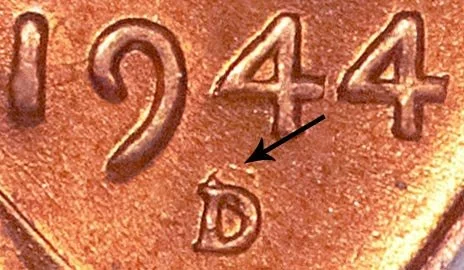
1944 penny D/S overmintmark error

1944-D/S Overmintmark — traces of S visible beneath D under 10x

During wartime die preparation, San Francisco’s working dies were shipped to Denver and repunched with a “D.” On many dies, the original “S” was not fully removed before the “D” was applied. The FS-511 variety shows the S curves to the lower-left; the FS-512 shows the S to the right of the D.

How to identify: Examine mintmark under 10x magnification • Look for curved remnants of “S” extending beyond the “D” boundary • FS-511 most prominent variety

Value: $20–$150 (circulated) — $49,938 (MS67+ RD Heritage 2020)

Error #3: Doubled Die Obverse (DDO)

Hub doubling on LIBERTY, date, and portrait details
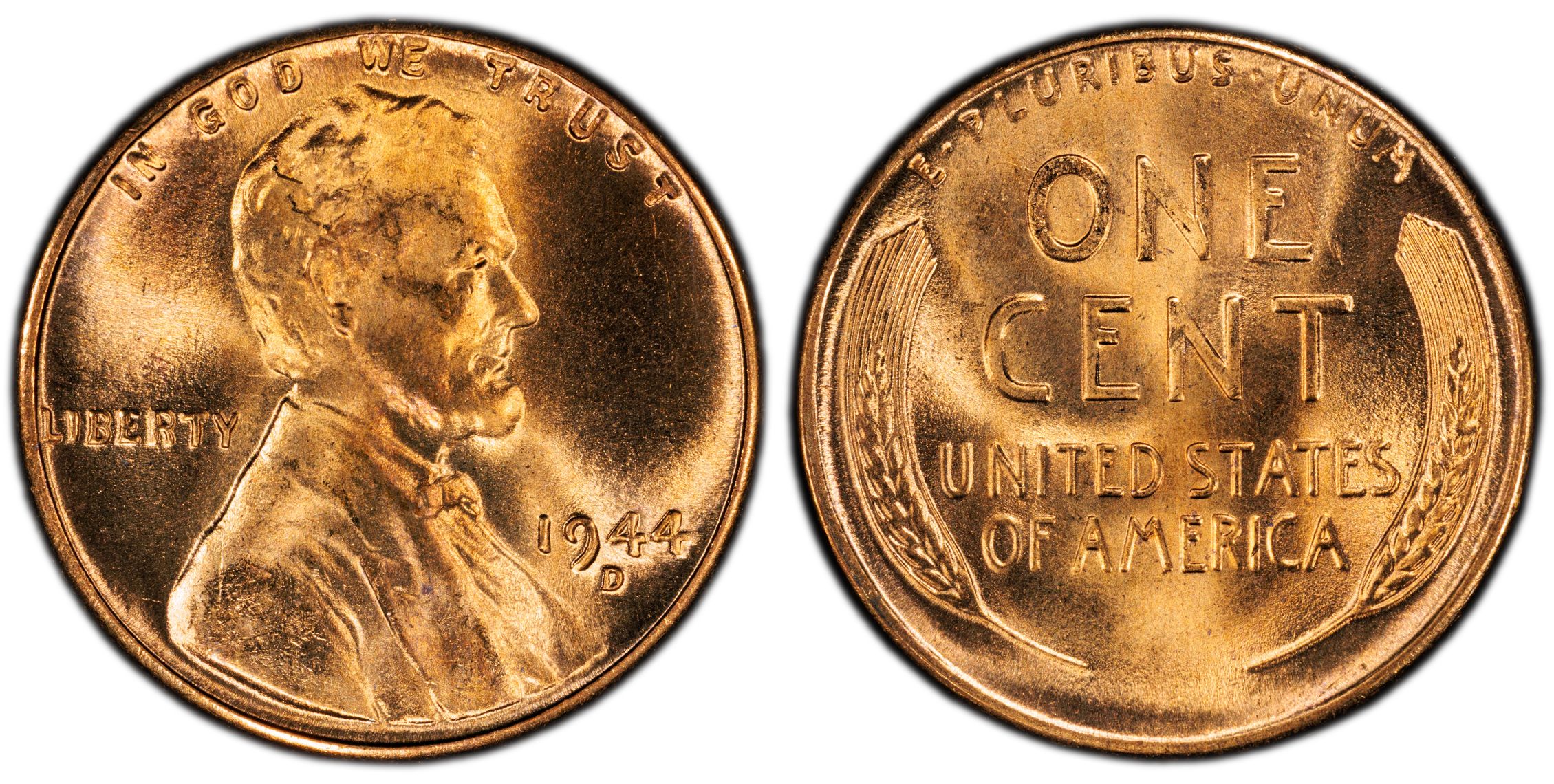
1944 penny doubled die obverse error

1944 DDO — doubling visible on LIBERTY and date numerals

Doubled die errors result from the working die receiving multiple hub impressions at slightly different angles or positions during manufacture. Strong varieties show clear letter separation on LIBERTY and date numerals, visible with the naked eye. Weak varieties require 10x magnification.

How to identify: Look for split or notched serifs on letters • Check the “4” numerals and Lincoln’s eye • Genuine hub doubling shows clear mechanical separation (not blurring from wear)

Value: $25–$100 (circulated) — $100–$1,000+ (MS, strong variety)

Error #4: Off-Center Strike

Misaligned planchet creates partial design with blank crescent
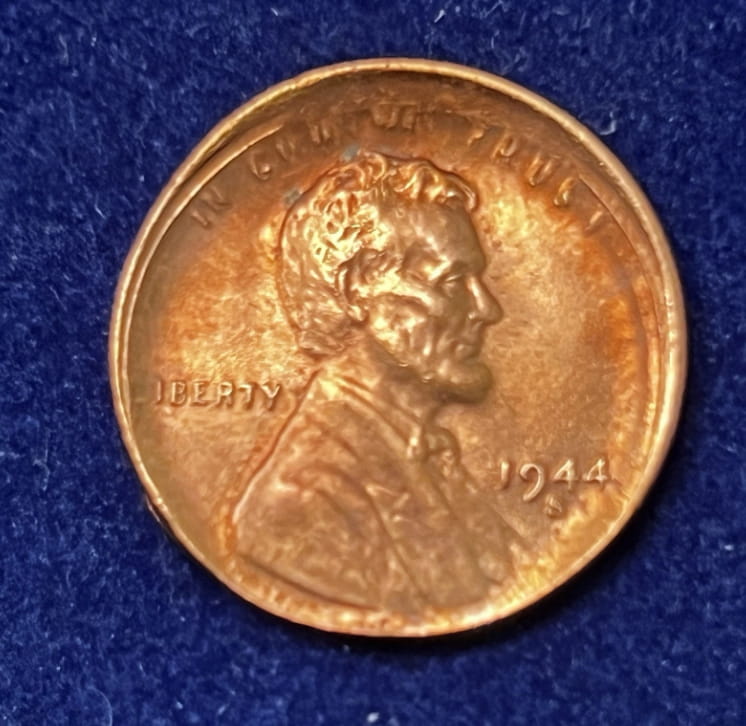
1944 penny off-center strike error

1944 Off-Center Strike — visible blank area, date retained

Occurs when the planchet is not properly centered under the dies at the moment of striking. The degree of misalignment directly affects value: small 5–10% offsets add modest premiums, while dramatic 40–50% examples with full dates visible command strong collector interest.

Value drivers: Date must be fully visible • Higher offset % = higher value • Uncirculated surfaces bring 2–3x premium over circulated • Two-sided off-center strikes extremely rare

Value: $20–$75 (5–15%) — $150–$400 (40%+, date visible, MS)

Error #5: Clipped Planchet

Missing metal segment from the blanking process
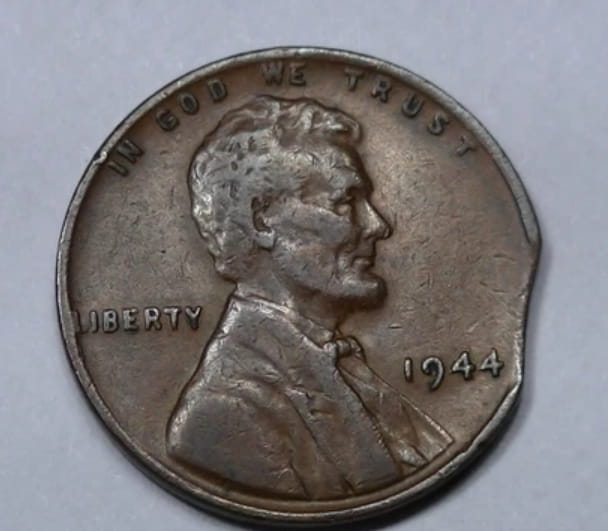
1944 penny clipped planchet error

1944 Clipped Planchet — curved clip from overlap during blanking

Clipped planchets form when the metal strip feeding the blanking press is not advanced correctly, causing a new blank to overlap a previous punch hole. Curved clips (from overlapping round holes) are most common. Straight clips occur at the strip’s edge. Double clips — two missing areas — are considerably rarer and more valuable.

Value factors: Larger clip = more valuable • Date and mintmark must remain visible • Double clips bring 3–5x premium • Irregular “Ragged” clips are rarest

Value: $10–$50 (small clip) — $75–$200+ (large clip, MS)

Error #6: Double Denomination (Dime Planchet)

Cent dies struck on a dime planchet — extreme rarity
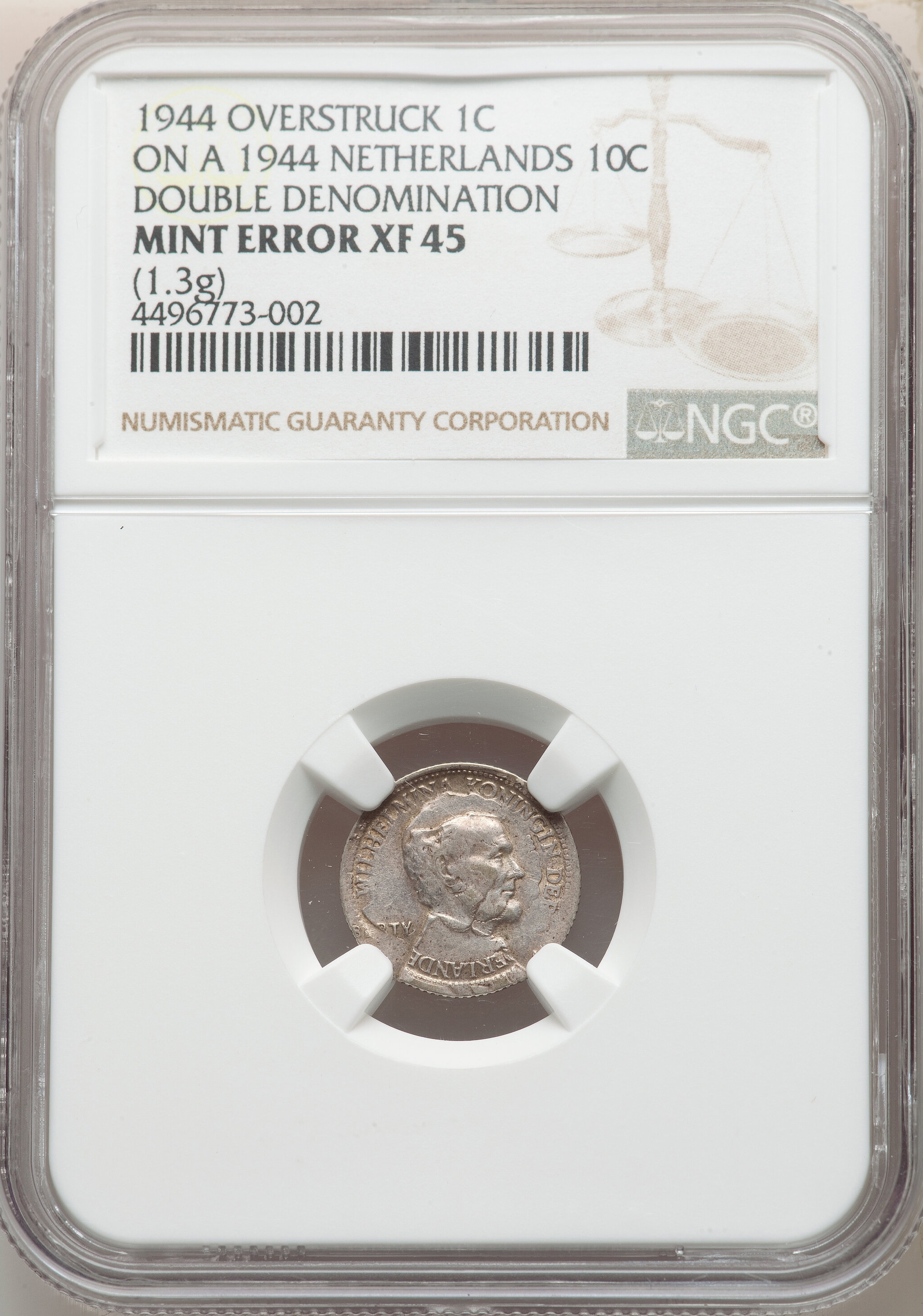
1944 penny double denomination dime planchet error

1944 Double Denomination — cent design on 17.9mm dime-size planchet

Among the most spectacular minting errors are double denomination strikes, where a coin is struck with dies intended for a different denomination. These occur when a dime planchet (17.9mm diameter, ~2.5g) enters the cent production line and receives a full cent strike. The size discrepancy is immediately visible.

How to identify: Noticeably smaller than a normal cent (17.9mm vs 19.05mm) • Lighter weight ~2.5g • Same Lincoln obverse / wheat reverse design • PCGS/NGC mandatory for authentication

Note:

Only a handful of genuine 1944 double denomination errors are known. Values are speculative but authenticated examples have sold privately for six figures. Unverified claims are common.

Value: $100,000–$500,000+ for authenticated examples


Recent Auction Results

Verified public auction records — establishes real market values

Coin Grade Sale Price Auction House Date
1944-S Steel CentPCGS MS-66$408,000Heritage ANAAug 2021
1944-P Steel CentPCGS MS-64$180,000Heritage2021
1944-D Steel CentPCGS MS-63$115,000Heritage2007
1944-D/S OMMPCGS MS-67+ RD$49,938Legend Rare CoinOct 2020
1944-P Steel CentPCGS MS-64$158,625Heritage2013
1944-P MS-67+ RDPCGS MS-67+$1,200+GreatCollections2024
“The 1944-S steel cent is the undisputed crown jewel of the 1944 Lincoln cent series — just two examples are confirmed, and the 2021 Heritage sale at $408,000 reset the record entirely.”

Identify Your 1944 Penny with CoinKnow

The fastest way to check varieties, grades and error values

📷

Snap a Photo

Point your phone at the coin. CoinKnow analyzes both sides simultaneously, detecting steel vs copper composition from color signature.

🔍

Detect Errors

Automatic detection for DDO doubling, D/S overmintmark traces, off-center percentages, and clipped planchet measurements.

💰

Get Instant Value

RD/RB/BN color grading, Sheldon Scale grade estimate within 2 points, and real-time auction price comparisons.

Pro Workflow: 1944 Penny Authentication Steps

1.Photograph both sides under natural light — CoinKnow detects RD/RB/BN color automatically
2.Run magnet test — if coin responds, weigh to 0.01g precision before proceeding
3.Check mintmark under 10x — look for S serif remnants beneath Denver D
4.Review CoinKnow grade estimate and compare to recent Heritage/GreatCollections sales
5.Submit anything worth $200+ to PCGS or NGC for official certification
6.Track certified value over time using CoinKnow’s portfolio management tools

Reality Check & Action Plan

What most 1944 pennies are actually worth — and when to get excited

Scenario Realistic Value Action
Magnetic, silver-gray, 2.70g$75,000–$408,000PCGS/NGC immediately — insure first
D mint with S visible beneath$50–$49,938Grade & variety attribution
Strong doubling on LIBERTY/date$100–$1,000Authenticate variety first
MS-65+ RD, any mint$25–$200Consider grading if RD intact
Circulated copper, any mint$0.05–$0.75Keep for type/date sets
Cleaned, damaged, corrodedFace valueDo not submit for grading
  1. 1.Never clean your coin. Cleaning destroys original surfaces and eliminates any premium — even on steel errors.
  2. 2.Magnet test first, always. A strong response is the most important single indicator of a potentially high-value coin.
  3. 3.Weight verification is mandatory. 2.70g = steel error candidate; 3.11g = standard copper.
  4. 4.Document everything before submitting — photos, weight, magnet reaction. This supports provenance.
  5. 5.Use PCGS CoinFacts or CoinKnow to compare against known authenticated examples before investing in professional grading fees.

The 1944 wheat penny sits at a remarkable crossroads of history and numismatics. Two billion copper cents forged from battlefield shell casings represent one of the most extraordinary origin stories in American coinage — and within that ocean of common coins, a handful of steel errors represent some of the most valuable Lincoln cents ever struck. For most collectors, a 1944 penny is an affordable and historically meaningful addition to any wheat cent collection. For the rare few who find a magnetic specimen that weighs 2.70 grams, it could be a life-changing discovery.

“The 1944 wheat penny is proof that value has nothing to do with age or face value, and everything to do with what happened between the raw material and the finished coin.”